Continuous, Active Federated Learning for Data Streams
Research & Experiment Plan
Working document for project lead, partners, and potential students. This page is the always-read core — the framing every non-trivial task needs. Detail lives in the sibling files linked below; open one only when the task calls for it (see the routing table).
Tags: [STD] standard / re-implement · [EXT] extend an existing method to our setting · [NEW] genuine
contribution absent from prior art.
Scope
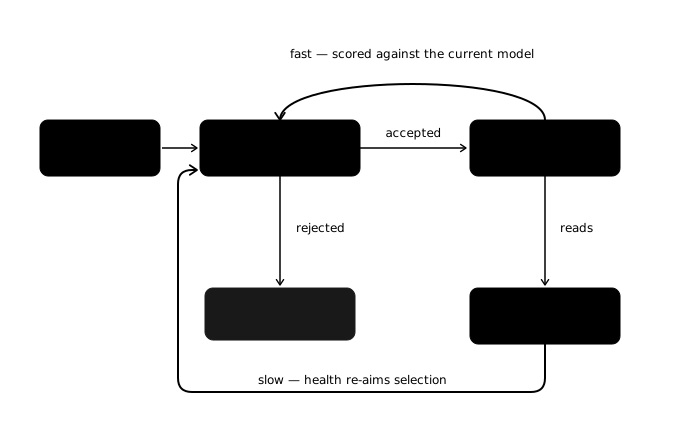
In scope: learning loop: AL as a label-free streaming filter ↔ trainable SSL backbone, trained using FL over these transient data streams → learning health monitoring / continual learning health metrics → filter correction. For the AL filter, analyze the performance-vs-storage Pareto front.
Out of scope: solving catastrophic forgetting (CF) end-to-end (instead: demonstrate + opportunistically mitigate), or FL efficiency or privacy attacks (rely on privacy-by-design).
Experimental framing: the independent variable (the knob we turn) is the filter selection, together with a choice of open-loop or closed-loop setting (i.e. whether the filter is static, or steerable). The health metrics are the dependent variable / readout (the thermometer), and the finding about the coupled system is the contribution, not any single filter, unless we can show a filter design (e.g. steerable, vs. static) that outperforms others on the health and downstream (e.g. classifier-level) metrics.
In open-loop (Phases 0–2) the base filter is the independent variable: fixed per run, stock knobs, read the thermometer. In closed-loop the independent variable moves up a level to the control policy (open vs. closed, and the controller design), holding the base filter fixed. Closing the loop requires a filter that exposes a steerable operating point — see N-G.
The loop — two feedback edges
The "loop" is two feedback edges, and naming them keeps the experiments clean:
-
Fast (inner): model → filter. The filter scores informativeness against the current backbone, so as the model adapts, what counts as novel/surprising shifts. This edge is intrinsic to any streaming filter and is what creates the coupled dynamics (and the pathologies).
-
Slow (outer): monitor → filter. The health monitor detects which degradation mode is setting in and re-aims selection accordingly. Example: rank dropping (collapse) → push toward coverage; probe-on-past falling (forgetting) → retain/replay under-covered past; overspecialization → down-weight the over-selected mode. This edge is what corrects the pathologies, and it is what makes this a loop rather than a pipeline.
Proposed novelty at a glance
The space is crowded along each axis; the assembly is not. The contribution is the closed loop as a live system, not any single axis. Full statements + the closest prior work each claim stands against are in novelty.md.
- N-A — The coupling, run as a live loop
[NEW]. The two edges operate together, studied live: fast (model→filter)- slow (monitor→filter). Prior links selection→collapse offline / does streaming selection with no health loop.
- N-B — Does the budget flip survive co-adaptation?
[NEW]Coverage wins at small budgets, novelty at large — does the flip hold under single-pass causal selection against a model the selection is itself changing? - N-C — Self-reinforcing selection (in)stability
[NEW]. Selection drives the model, which changes what is selected next — may degenerate or be stabilized; and how FL averaging amplifies or damps it. - N-D — Selection × aggregation skew in FL
[NEW]. Independent clients over-selecting local tails skew the aggregate; global-aware selection may correct it. - N-E — Online health-monitor → control loop
[NEW]. A multivariate health signal as a live controller (not a diagnostic) — modulating selection, scheduling replay/rollback. - N-F — Federation-level health analytics
[NEW]. Flag a degraded client via representation health before its update poisons the global model — the server-side twin of the on-device monitor. - N-G — Health-steerable filter (the actuator)
[NEW]. Coverage↔novelty mixα+ acceptance rate as a live function of the health signal — the actuator that makes the loop closable.
Everything else is [STD] or [EXT]. New work maps to one of N-A…N-G, or it is scope drift.
Plan
Core philosophy: the filters are knobs, not the result; the high level system design is ours. Lead with the cheap existential system-wide experiment, not a filter design. Filter (or other sub-component design) can come later, once the system dynamics are studied (using known subcomponents).
High level methodology
- Build the streaming loop + measurement apparatus (effective rank / RankMe, probe-on-past, frozen-backbone baseline B5, etc.) and a positive control per failure mode (see Phase 0). Loop is composed of known methods.
-
With cheap knobs only (no-filter / random / dedup / loss), on a correlated stream, establish:
-
(a) model adaptation beats frozen model
- (b) streaming induces measurable degradation
- (c) the knob measurably moves the health trajectory.
If (a) or (b) fails, reframe immediately. The steerable filter and the closed loop (N-E, N-G) come last, once the pathologies are shown to exist and the monitor is built. We can't close a loop to correct a problem we haven't demonstrated.
Implementation
The building blocks (possible implementations of the individual elements of the figure in the Scope section) to consider are listed in building-blocks.md. Using these, we design a sequential scientific spine that underpins our experiment plan and implementation roadmap.
- Phase 0 — Instrument calibration
[STD]. Each failure mode's instruments (metrics) calibrated — its PC fires, a healthy baseline stays quiet. - Phase 1 — Degradation envelope
[NEW]. 1a STL-10 pilot (synthetic correlation) → 1b BDD100K (real, make-or-break); sweep pressure incl. initialization Go: a coupling exists. No-Go: reframe to selection-for-efficiency. - Phase 2 — Open-loop criterion study
[NEW]Centralized; Explore budget flip: at small budgets coverage wins, at large budgets novelty wins. Does the flip survive co-adaptation; does the loop self-reinforce? - Phase 3 — Closed loop
[NEW]Centralized; build the monitor→filter controller; open vs. closed-loop ablations on health + downstream. - Phase 4 — ZOD confirmation
[EXT](pretrained-adapt, realistic scale) - Parallel tracks. FL, Monitoring (built once Phase 1 confirms degradation, ready by Phase 3).
Where to read more
| Working on… | Read |
|---|---|
A [NEW] contribution / positioning vs. prior art |
novelty.md |
| SSL backbones, filter families (F-a/F-b/F-c), datasets | building-blocks.md |
| Setting up / running a phase — baselines, factor levels, grids | experiments.md |
| Measurements, health monitor, evaluation protocols | metrics.md |
| Citations / lit-review | reading-list.md |
| Phase planning, interpreting a null | risks.md |